




rewrite this content using a minimum of 1200 words and keep HTML tags
Crypto charts can look convincing right before they trap you. Price jumps, volume spikes, everyone suddenly sounds sure. Then the move fades, and you’re left wondering whether the signal was real or just noise. The Money Flow Index (MFI) helps you check that pressure before you act. It won’t make trading risk-free, but it can show whether a move has real volume behind it.
What Is the Money Flow Index in Crypto?
The Money Flow Index (MFI) is a technical analysis tool, momentum oscillator, and volume-based indicator. It helps you measure buying or selling pressure by combining price and volume data instead of reading price alone.
In money flow index crypto analysis, the indicator works on any exchange trading pair that provides high, low, close, and volume data. The MFI indicator then converts that information into an oscillator value between 0 and 100.
The Money Flow Index is commonly credited to Gene Quong and Avrum Soudack. It came from traditional financial markets, but it fits crypto trading because crypto charts use the same core inputs: price data, trading volume, and a selected lookback period.
What MFI Can and Can’t Tell You
The Money Flow Index can highlight pressure and possible exhaustion, but it can’t guarantee reversals or profitable trades. High readings may suggest buying pressure is stretched. Low readings may suggest selling pressure is stretched. Neither reading is a standalone buy or sell signal.
Like many technical indicators, the Money Flow Index uses historical market data. That makes it a lagging indicator in the practical sense: it reacts to price movement and volume that already happened. Some traders also treat volume as a leading indicator because changing participation can appear before a clear price reversal. Both ideas can be useful, but neither removes risk.
The MFI indicator works best with context. Use it with support and resistance, trendlines, moving averages, MACD, RSI, or broader market conditions. Strong trends, low liquidity, and unreliable volume can all generate false signals.
How to Get Free Crypto
Simple tricks to build a profitable portfolio at zero cost

The Core Idea Behind MFI: Money Flow
Money flow is price movement filtered through volume. If price rises while trading activity expands, the market may show real demand. If price falls on strong volume, negative money flow may point to heavier selling pressure.
The Money Flow Index reads this through each candle’s typical price. When today’s typical price rises versus the previous candle, the raw money flow is counted as positive money flow. When it falls, it becomes negative money flow.
This is why the flow index can offer valuable insights that price-only tools miss. It blends price and volume, so you can judge whether a move reflects stronger participation or thin market behavior.
The Key Inputs MFI Needs
The Money Flow Index needs five inputs: high price, low price, close price, trading volume, and a lookback period. Together, they help the MFI indicator measure buying or selling pressure across different crypto assets and trading strategies.
High Price
High price is one part of the typical price formula. It helps capture the upper end of the candle instead of relying only on closing prices.
Low Price
Low price captures the lower end of the candle. This gives the Money Flow Index more context during volatile sessions where intraperiod extremes reveal pressure.
Close Price
Close price completes the typical price formula. The close often anchors how a candle is read, but the MFI indicator combines it with the candle’s full range and volume data.
Trading Volume
Trading volume is what makes the Money Flow Index different from many price-based oscillators. MFI incorporates volume, so it can show whether price action had real participation behind it.
Lookback Period
The lookback period tells the flow index how many candles to include. The common default is 14 periods, but you can adjust it based on your timeframe and trading approach.
How the Money Flow Index Is Calculated
The Money Flow Index calculation moves through five steps: typical price, raw money flow, positive and negative money flow, money flow ratio, and the final MFI value.
Step 1: Calculate Typical Price
Typical price is a derived price metric. It’s calculated as: (High + Low + Close) ÷ 3. This gives the MFI indicator a balanced candle value before volume enters the formula.
Step 2: Calculate Raw Money Flow
Raw money flow equals typical price multiplied by volume. Formula: Typical Price × Trading Volume.
For example, if the typical price is 55 and volume is 7,000, raw money flow is 385,000. This step turns a candle into a volume-aware money flow reading.
Step 3: Separate Positive and Negative Money Flow
Positive money flow happens when typical price rises versus the previous period. Negative money flow happens when typical price falls.
Over the lookback period, the indicator adds positive money flow values and negative money flow values separately. This split lets the Money Flow Index compare buying pressure with selling pressure.
Step 4: Calculate the Money Flow Ratio
The money flow ratio compares positive money flow with negative money flow. The formula is: Positive Money Flow ÷ Negative Money Flow.
If positive money flow is 490,000 and negative money flow is 210,000, the money ratio is about 2.33. A higher money flow ratio suggests stronger inflows. A lower money ratio suggests stronger outflows.
Step 5: Convert the Ratio Into the Final MFI Value
The final formula is: MFI = 100 − 100 ÷ (1 + Money Flow Ratio).
This converts the ratio into a bounded oscillator. MFI values always sit between 0 and 100, which makes the Money Flow Index easier to compare across periods and assets.
How to Read the MFI Scale
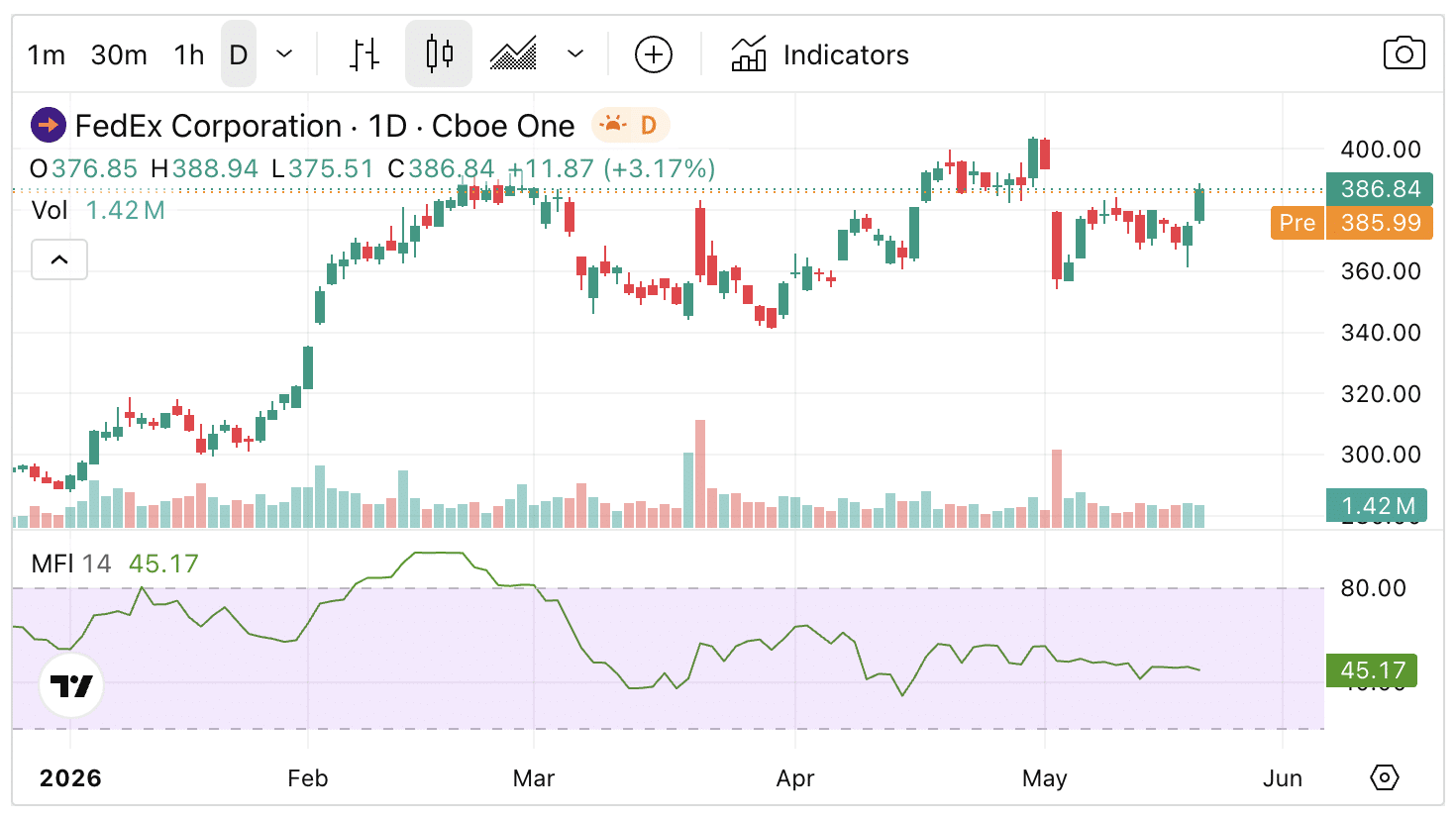
The 0–100 scale helps you read pressure at a glance. High readings point to stronger buying pressure. Low readings point to stronger selling pressure. The key is not to treat those readings as automatic trading decisions.
What the 0–100 Range Means
The Money Flow Index shows whether money flow is leaning positive, negative, or neutral. It helps frame market dynamics, not predict the next candle with certainty.
MFI Above 80: Overbought Conditions
An MFI reading above 80 is commonly treated as an overbought condition. It can warn that buying pressure may be stretched and that a price reversal is possible.
But overbought or oversold conditions aren’t trade triggers by themselves. In strong uptrends, the MFI indicator can stay high for extended periods.
MFI Below 20: Oversold Conditions
An MFI reading below 20 is commonly treated as oversold. It can suggest stretched selling pressure and possible upside price reversal risk.
Still, oversold conditions don’t mean price has to bounce. Weak assets can keep falling, so use confirmation and risk management.
The 50 Line: Neutral Pressure Zone
The 50 line acts as a rough balance zone. Readings around it suggest that positive money flow and negative money flow are closer to even.
Why Crypto Traders Sometimes Watch 90/10 Extremes
Some crypto traders watch 90 and 10 instead of 80 and 20 in highly volatile or ranging markets. These levels are more extreme, but they’re optional. They’re not a universal rule or a reliable indicator on their own.
Core MFI Signals Crypto Traders Watch
The most common MFI signals include rising or falling readings, divergences, failure swings, and breakout confirmation. Each one can signal potential reversals or trend strength, but each needs confirmation.
1. Rising MFI and Buying Pressure
A rising Money Flow Index can suggest increasing buying pressure, especially when price rises too. This setup may confirm that a move is supported by meaningful participation.
2. Falling MFI and Selling Pressure
A falling Money Flow Index can suggest increasing selling pressure or weakening demand. If price rises while the MFI falls, they’re moving in the opposite direction, which can warn that the trend is losing support.
3. Bullish Divergence
Bullish divergence happens when price makes a lower low while the MFI makes a higher low. It may show weakening selling pressure and potential reversals to the upside.
4. Bearish Divergence
Bearish divergence happens when price makes a higher high while the MFI makes a lower high. It can suggest weakening buying pressure and a possible downside price reversal.
5. Failure Swings
Failure swings are oscillator-based reversal patterns. The MFI indicator tries to reach an extreme, fails, and turns away. This can show fading momentum even without a clear price divergence.
6. Breakout Confirmation
You can also use the Money Flow Index to check breakout quality. If price breaks resistance and the flow index rises too, the breakout may have volume-backed participation. If price breaks out while MFI stalls, the move may be weaker than it looks.
MFI vs. RSI: What’s the Difference?
The Money Flow Index and Relative Strength Index are both momentum oscillators. The difference is simple: RSI measures price momentum, while MFI adds volume.
RSI Measures Price Momentum
The Relative Strength Index uses closing prices to track the speed and size of recent price movement. It’s easy to read, but it doesn’t consider volume.
MFI Adds Volume
Unlike RSI, the Money Flow Index combines price and volume data. That’s why traders often describe it as a volume weighted RSI.
MFI is not automatically better. It just answers a slightly different question: did the move have participation behind it?
When MFI and RSI May Disagree
MFI and the Relative Strength Index can disagree. RSI may rise while MFI falls, which can mean price momentum looks strong but volume-backed money flow is weakening.
Which One Should Crypto Beginners Use?
Neither tool is best in every case. If you’re new, start with one oscillator and learn how it behaves before stacking other technical indicators on top.
MFI vs. Other Volume Indicators
MFI is only one volume-based tool. Chaikin Money Flow and On-Balance Volume also use volume, but they read market dynamics differently.
MFI vs. Chaikin Money Flow
Chaikin Money Flow and the Money Flow Index both use price and volume. The difference is scale and formula. CMF moves around a zero line, while MFI forms a bounded 0–100 oscillator.
MFI vs. On-Balance Volume
On-Balance Volume tracks cumulative volume direction by adding or subtracting volume on up or down periods. The Money Flow Index converts price-volume behavior into a bounded score, which can make extremes easier to compare.
Why Crypto MFI Signals Can Be Tricky
Crypto trading adds extra noise. Exchange-specific volume, liquidity gaps, 24/7 markets, and low-volume candles can all affect how the MFI indicator behaves.
Exchange-Specific Volume
The same crypto asset can show different volume patterns across exchanges. Since the Money Flow Index depends on trading volume, one charting platform may show a cleaner signal than another.
Unlike tick volume, which counts price updates, exchange volume should reflect traded volume. But crypto volume data can still vary by venue, so cross-checking helps.
Liquidity Differences Between BTC, ETH, and Small-Cap Altcoins
The Money Flow Index usually reads cleaner on BTC and ETH because deep liquidity reduces noise. Thin small-cap altcoins can move sharply on small orders, which can distort positive money flow, negative money flow, and the final signal.
24/7 Crypto Markets and Timeframe Choice
Crypto doesn’t have the same market close structure as stocks. A daily MFI reading can tell a different story from a 15-minute reading, so timeframe choice changes the signal.
Low-Volume Candles and Noisy Signals
Low-volume candles can make the flow index jump without real conviction. This is where MFI can generate false signals, especially in low-liquidity markets or short timeframes.
Common MFI Mistakes in Crypto Trading
Most MFI mistakes come from treating the indicator like a complete system. It’s one input for trading strategies, not a full strategy.
Treating Overbought as an Automatic Sell Signal
This fails in strong uptrends. The Money Flow Index can stay above 80 while price keeps climbing, especially when buyers keep supporting the move.
Treating Oversold as an Automatic Buy Signal
This fails in weak assets and downtrends. The MFI can stay below 20 while price keeps falling, so oversold levels need confirmation.
Ignoring Liquidity
Low liquidity can make MFI readings look stronger than they are. Before trusting any signal, check volume, spread, and execution risk.
Changing Settings Until the Chart Looks Perfect
Over-tuning the indicator creates overfitting, making settings that look perfect on historical data perform poorly in live markets.
Forgetting That MFI Is Not a Full Trading Strategy
The MFI indicator can support trading strategies, but it can’t replace risk management, position sizing, or a clear trading plan. Use it with other indicators and market context.
Best MFI Settings for Crypto: What to Know
There’s no perfect MFI setup for every coin or timeframe. Settings should match your trading approach, asset liquidity, and market conditions.
The Common Default: 14 Periods
The standard Money Flow Index setting is 14 periods. It balances responsiveness with smoothing and works as a reasonable baseline for most charts.
Shorter Settings: Faster but Noisier
Shorter settings, such as 7 or 10 periods, react faster. They may help with intraday crypto trading, but they also create more false positives.
Longer Settings: Smoother but Slower
Longer settings, such as 20 or 21 periods, reduce noise but react later. They’re often more useful for broad trend context than quick entries.
Timeframe Examples: Intraday vs. Swing Trading
A short-term trader may test a faster MFI on 5-minute or 15-minute charts. A swing trader may prefer 14 or 21 periods on 4-hour, daily, or weekly charts. Don’t chase a universal setup. Test what fits your timeframe.
Final Thoughts
The Money Flow Index can help you see whether price action has volume behind it. That makes it useful for spotting pressure, exhaustion, divergence, and weak breakouts. But don’t use it alone. Crypto moves fast, and thin markets can fool clean-looking signals. Pair MFI with structure, confirmation, and risk management, then treat every reading as context—not a command.
FAQ
Is MFI good for Bitcoin trading?
Yes, MFI can work well on Bitcoin because BTC usually has deep liquidity and strong volume data. Still, use it with price action, support and resistance, and broader context.
What is the best MFI setting for crypto?
The common default is 14 periods. Shorter settings react faster, while longer settings smooth noise but respond later.
Is MFI better than RSI?
Not always. Unlike RSI, MFI adds volume, while the Relative Strength Index reads price momentum only.
Can MFI predict crypto reversals?
No indicator can predict reversals with certainty. MFI can highlight potential reversals through divergences, extremes, and failure swings.
Does MFI work on low-cap altcoins?
It can, but signals are often noisier. Low liquidity and uneven volume can distort the Money Flow Index.
Should beginners use MFI alone?
No—beginners should combine MFI with trend analysis, support and resistance, other indicators, and risk management.
What indicators work well with MFI?
MFI works well with RSI, MACD, moving averages, support and resistance, and trend following indicators. Together, they give a more comprehensive view than MFI alone.
Disclaimer: Please note that the contents of this article are not financial or investing advice. The information provided in this article is the author’s opinion only and should not be considered as offering trading or investing recommendations. We do not make any warranties about the completeness, reliability and accuracy of this information. The cryptocurrency market suffers from high volatility and occasional arbitrary movements. Any investor, trader, or regular crypto users should research multiple viewpoints and be familiar with all local regulations before committing to an investment.
and include conclusion section that’s entertaining to read. do not include the title. Add a hyperlink to this website http://defi-daily.com and label it “DeFi Daily News” for more trending news articles like this
Source link