




rewrite this content using a minimum of 1200 words and keep HTML tags
So you just bought your first crypto. Now what? Your crypto wallet decides who really controls your new coins. In the custodial vs. non-custodial debate, one choice gives convenience, and the other gives you complete control. One holds your private keys for you. The other puts them in your hands.
This guide breaks down custodial and non-custodial wallets, so you know what you’re signing up for and what you risk losing, in both cases.
What Is a Custodial Wallet?
In a custodial wallet, a third party controls your private keys on your behalf. That third party is usually a crypto exchange or another financial service provider. You access your funds through an account, not through key ownership. And if they control the keys, they control access to your crypto assets.
This model feels familiar because it works like online banking. You log in, reset passwords, and contact customer support if something breaks. Everything is done on the provider’s platform with no extra hassle, and someone else handles asset custody, security infrastructure, and regulatory compliance for you. In exchange, though, you give up full control and accept counterparty risk—which means your access depends on the provider’s stability and policies.
Examples
Most custodial wallets live inside large crypto exchanges or other similar platforms. When you hold crypto on an exchange, you’re using a custodial wallet, even if the interface calls it a balance or account. The platform remains the sole custodian of the private keys and the underlying crypto.
Common custodial wallet examples include:
CoinbaseA regulated US-based exchange offering custodial wallets with account recovery options and compliance controls.
BinanceA global exchange providing custodial wallets optimized for active trading.
KrakenAn exchange focused on security and compliance, with custodial storage by default.
What Is a Non‑Custodial Wallet?
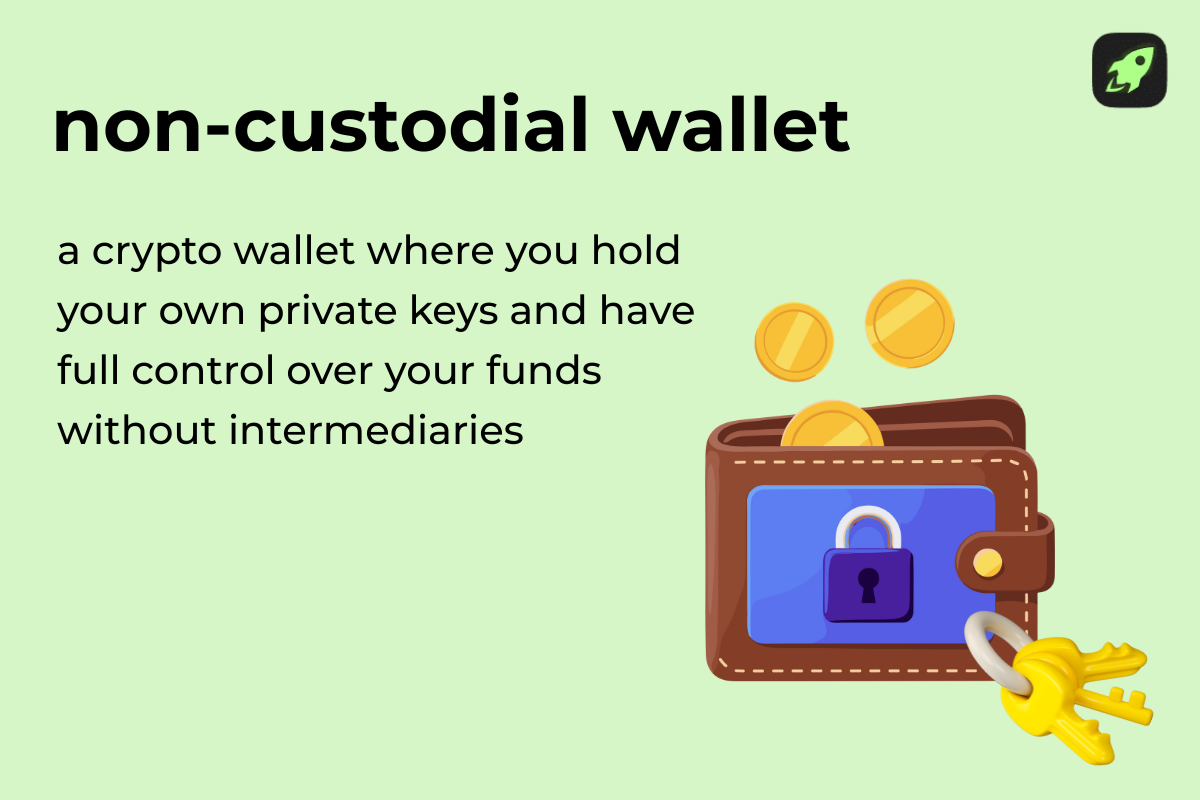
In a non-custodial wallet, you control your own private keys. No platform holds them for you, and you are the owner and operator of your crypto assets, with full control over how they move and where they live. This setup follows the core idea of self-custody. When you create a non-custodial wallet, the software generates a seed phrase (a set of recovery words that restore access). That phrase is how you own your private keys. If you lose it, you lose access permanently. That responsibility is the price of independence.Non-custodial wallets usually avoid KYC (Know Your Customer) and Anti–Money Laundering (AML) checks, because no intermediary touches your digital assets. You sign transactions directly on the blockchain using your keys, which makes these crypto wallets essential for Web3 use cases like DeFi integration, NFTs, and decentralized apps. You gain autonomy, privacy, and flexibility. Still, remember that you also accept sole responsibility for security, and no one can help you if it fails.
Examples
Most non-custodial wallets are either software apps or hardware wallets that store your keys locally instead of on a server. They can work across mobile devices, browsers, or physical devices, depending on the type of digital wallet.
Common non-custodial wallet examples include:
MetaMaskA browser and mobile wallet used to access DeFi and Web3 apps directly.
Trust WalletA mobile-first non-custodial wallet that supports many blockchains.
LedgerA hardware wallet that keeps your private keys secure offline.
TrezorOne of the earliest hardware wallets on the market, built for long-term self-custody.

How to Get Free Crypto
Simple tricks to build a profitable portfolio at zero cost

Key Differences Between Custodial and Non-Custodial Wallets
Before diving into detailed comparisons of these two types of crypto wallet, it helps to see the main difference at a glance. This table sets the baseline for everything that follows.
Custodial vs. Non-Custodial Wallets
Now let’s break the comparison down in more detail. Pay attention to the trade-offs and think about which one will work best for you, based on how you plan to use crypto.
Private Key Ownership
With custodial wallets, the platform controls all private keys. You never see them, and can’t access them yourself. Still, this setup removes the burden of key management from you, and reduces the risk of accidental loss.
On the other hand, with a non-custodial wallet, you own the private keys directly. That ownership means control. But if you lose the keys, you lose all your funds. This rule is absolute, and there are no exceptions.
Access Control
Custodial wallets grant access through an account system. If the platform restricts or suspends your account, you must wait for resolution from them. Your access depends on internal rules, reviews, or regional restrictions.
Non-custodial wallets rely only on key access. If you control the keys, you control the wallet. No third party can block transactions or freeze balances. Access remains fully in your hands.
Security
Custodial wallets centralize security. Providers protect large pools of user funds using layered defenses such as encryption, internal controls, and two-factor authentication (2FA). This approach reduces individual mistakes but still creates a single point of failure.
Non-custodial wallets remove that central target. There is no shared vault to attack. Security depends on how well you protect your keys and devices. The risk shifts from systemic failure to personal error.
Backup & Recovery
Custodial wallets offer recovery options. If you forget your credentials, you can usually restore access through customer support. This safety net appeals to users who value convenience.
Non-custodial wallets only rely on a seed phrase. This phrase is the only backup. Lose it, and you lose access forever. No service can restore it. Responsibility is absolute.
Ease of Use
Custodial wallets prioritize simplicity. Their interfaces feel familiar, and workflows mirror online banking. Many users rely on this model because it lowers friction and speeds up onboarding.
Non-custodial wallets require setup and attention. You must secure backups and understand basic wallet mechanics. The experience improves with use, but the learning curve never fully disappears.
Regulatory Compliance
Custodial wallets operate under strict regulatory compliance frameworks. Most require KYC and AML checks. These controls protect platforms and users but reduce privacy.
Non-custodial wallets operate without identity checks. No intermediary controls the funds, so no verification is required. Transactions remain on-chain and pseudonymous.
Transaction Approval
With custodial wallets, transactions must pass through internal systems before reaching the blockchain. Platforms may impose limits, delays, or reviews based on policy.
With non-custodial wallets, you approve transactions directly through transaction signing using your private keys. Once signed, the blockchain processes the transaction without intermediaries.
Risk of Hacks or Theft
Custodial wallets expose users to counterparty risk. Exchange failures and large-scale breaches can lock or drain funds across many accounts at once.
Non-custodial wallets avoid that exposure. There is no shared vault to breach. The primary risk comes from phishing attacks, malicious software, or unsafe key storage.
Access to DeFi and Web3
Custodial wallets offer limited access to Web3 features. Most decentralized protocols require direct wallet connections that custodial platforms do not support.
Non-custodial wallets offer full DeFi integration. You can interact directly with decentralized exchanges, lending protocols, and NFT platforms without needing permissions.
Internet Connection
As a rule, custodial wallets are also hot wallets, meaning they operate online at all times. Access depends on platform availability and connectivity. This can make them more risky as it increases their attack surface.
Non-custodial wallets, especially hardware wallets, can store keys offline, which makes them a type of cold wallet. Funds remain isolated until you connect to sign a transaction, reducing online exposure as much as possible.
Suitable For
Custodial wallets best suit beginners, active traders, and institutional investors who value convenience and structured oversight.
Non-custodial wallets are best suited for users who prioritize full control, long-term storage, and direct blockchain interaction. Experience and discipline matter here.
Multi-Device Access
Since they’re always online, custodial wallets also sync automatically across devices. You can log in anywhere and resume activity instantly.
Non-custodial wallets require manual setup on each device. Access requires restoring the wallet using secure backups, increasing personal responsibility.
Data Privacy
Custodial wallets collect personal data and activity records. Privacy depends on the provider’s data practices and jurisdiction.
Non-custodial wallets collect no personal data. Only public blockchain information exists. You decide what information you share, and when.
Pros and Cons of Custodial Wallets
Custodial wallets remove complexity and handle security for you, but they also introduce dependency on a third party. Here’s how their pros and cons compare.
Pros and Cons of Non-Custodial Wallets
With non-custodial wallets, you get control and privacy, but everything depends on how well you manage your keys and backups.
Examples of Custodial and Non-Custodial Wallets
Here are some popular examples of custodial wallets. They exist inside platforms that manage keys and user funds for you, and prioritize convenience, compliance, and support.
CoinbaseA US-based exchange offering crypto wallets with account recovery, KYC, and regulatory oversight.
BinanceA global trading platform with wallets designed for frequent crypto transactions and liquidity.
KrakenA security-focused exchange providing wallets under strict compliance standards.
Crypto.comA mobile-first wallet platform with cards, staking, and trading features.
BitstampOne of the longest-running exchanges, offering custodial storage with institutional-grade controls.
Fintech crypto appsApps such as PayPal or Robinhood, which let you buy and hold crypto without exposing your private keys, often limiting withdrawals or transfers.
Here are some popular non-custodial wallet types. These give you complete control over keys and require active private and public key management, with no intermediary in control.
MetaMaskA browser and mobile wallet used for Web3 apps, NFTs, and decentralized exchanges.
Trust WalletA mobile-first wallet supporting many blockchains and tokens with full self-custody.
LedgerA hardware wallet that keeps private keys safe offline using physical devices.
TrezorOne of the earliest hardware wallets built for long-term storage and independent key ownership.
ExodusA desktop and mobile wallet focused on user experience while preserving full control.
ElectrumA lightweight wallet designed for advanced users who want fine-grained control.
Which Wallet Type Is Better for Beginners?
If you’re just starting out, a custodial crypto wallet would make more sense. There’s less friction, since you don’t manage private keys. You can reset passwords. You have customer support if something goes wrong. There are familiar interfaces, and you can log in from any device. You can buy, sell, and move your digital assets with just a few clicks.
That said, convenience has limits. As you gain confidence, and invest more into crypto, a non-custodial wallet becomes valuable. It teaches you how crypto actually works. You learn self-custody, private key management, and how to protect a seed phrase. Many users adopt a hybrid approach—custodial wallets for active trading, and non-custodial wallets for long-term storage.
How to Choose the Right Wallet for Your Needs
The choice between custodial vs. non-custodial wallets depends on how you plan to use crypto and how much responsibility you want. Ask yourself these questions before you decide.
Do you want convenience or control?If you value speed and simplicity, custodial fits better. If you want complete control and ownership, a non-custodial setup makes more sense.
How comfortable are you with managing private keys?Managing private keys and a seed phrase requires care and can be dangerous if done wrong. If that feels risky right now, start custodial.
Will you trade often or hold long term?Active trading works well on crypto exchanges with custodial wallets. Long-term storage favors non-custodial options, especially hardware ones.
Do you need access to DeFi or Web3?Most Web3 tools require a non-custodial wallet. If you plan to use decentralized exchanges or DeFi protocols, custodial wallets will limit you.
How much privacy do you want?Custodial wallets require KYC and follow regulatory compliance rules. Non-custodial wallets avoid identity checks and offer more autonomy.
What is your risk tolerance?Custodial wallets reduce user error but add counterparty risk. Non-custodial wallets remove intermediaries but increase user’s responsibility.
Final Thoughts
Choosing between custodial vs. non-custodial wallets comes down to one thing: how much control you want. Custodial options favor ease and support. Non-custodial crypto wallets favor ownership and independence. Both serve a purpose.
Start where you feel comfortable. Learn how each type works. Move toward more independent options when you’re ready. In crypto, understanding your wallet is understanding your risk—and your freedom.
FAQ
What’s the difference between a wallet and an exchange?
A wallet stores and manages your crypto, while an exchange lets you buy, sell, and trade it. Most crypto exchanges include a custodial wallet by default, but you do not control the private keys there.
Read more: Crypto Exchange vs. Wallets: Key Differences
Can someone steal my crypto from a custodial wallet?
Yes. If the platform is hacked, mismanages funds, or restricts withdrawals, your crypto can be affected. You rely on the provider’s security and policies to protect user funds.
Is it easier to get scammed using a non-custodial wallet?
It can be. Scams like phishing attacks target users directly, often by tricking them into revealing a seed phrase. If you share your keys, all your digital assets are as good as gone.
Can I switch from a custodial wallet to a non-custodial wallet later?
Yes. You can withdraw crypto from a custodial platform to a non-custodial crypto wallet at any time by sending it to your new wallet address.
Is it risky to use a non-custodial wallet as a beginner?
It can be if you skip the basics. Start small, secure your seed phrase, and learn gradually. With care, beginners can use non-custodial wallets safely.
Disclaimer: Please note that the contents of this article are not financial or investing advice. The information provided in this article is the author’s opinion only and should not be considered as offering trading or investing recommendations. We do not make any warranties about the completeness, reliability and accuracy of this information. The cryptocurrency market suffers from high volatility and occasional arbitrary movements. Any investor, trader, or regular crypto users should research multiple viewpoints and be familiar with all local regulations before committing to an investment.
and include conclusion section that’s entertaining to read. do not include the title. Add a hyperlink to this website http://defi-daily.com and label it “DeFi Daily News” for more trending news articles like this
Source link